American solar equipment supplier
Solar Panels, Inverters & Home Battery Systems
Power Your Home. Empower Your Life.
Shop solar panels, inverters, home batteries, off-grid kits and complete energy storage systems, with US-based help choosing compatible equipment.


Expert help before, during and after purchase.
US stock ships in 3-5 business days.
Safe checkout and transparent pricing.
Manufacturer warranty on qualified products.
Shop by Leading Brands










Find the Right Solar & Battery Solution for Your Needs

Whole-Home Backup
Keep most or all of your home running during power outages.

AC-Coupled to Existing Solar
Add storage to your existing solar system with solar retrofit options.

Hybrid Solar & Storage
Maximize savings with solar plus battery backup.

Off-Grid Solar Systems
Reliable power for remote locations, cabins and no-grid sites.

Commercial Energy Storage
Scalable solar and battery solutions for businesses and commercial projects.
Featured Solar & Battery Solutions

Sigenergy SigenStor-11.5-6.02~54.24 Home Energy System (With LoadHub) | 11.5kW | Split-Phase Hybrid | UL9540 Certified and CEC Listed

Growatt 20kWh Whole-Home Backup System Kit | MIN 11400TL-XH-US (V3) 11.4kW Storage Inverter + APX 20kWh High Voltage Battery + SYN 200-XH-US 11A

FranklinWH aPower 2 + aGate 15 kWh AC-Coupled Home Battery System For Existing Solar Retrofit

Best Seller
Select Your Desired Products from Best Seller Deals or Hot Products

Sigenergy SigenStor 11.5kW / 18.08kWh Home Backup System


Sigenergy Sigen EVDC V2X 25kW Bidirectional DC Charger


Growatt SPH 10000TL-HU-US (B) 10kW 48V Hybrid Inverter


Growatt MIN 11400TL-XH-US 11.4kW Grid-Tie Storage Inverter | Compatible with Growatt APX HV Battery


Solar Panels Sale


TALESUN 445W TOPCon Bifacial Full Black Solar BIPRO TM7G54M 16BB | Pallet ( 36 pcs ) 16.02kW


ZNSHINE 440W Full-Black N-Type Bifacial Dual Glass Solar Panel ZXM7-UHLDD108|Pallet (36 pcs ) 15.84kW


ZNSHINE 410W Full-Black Mono Perc Solar Panel | Pallet (36 pcs ) 14.76kW


ZNSHINE 550W Bifacial Dual Glass Mono Perc ZXM7-SHLDD144 | Pallet (36 pcs) 19.80kW


Talesun 590W Bifacial Dual Glass TOPcon 144-Cell Solar Panel TM7G72M | Pallet (36 pcs ) 21.24kW


Talesun 620W Bifacial Dual Glass TOPcon 144-Cell Solar Panel TM3G66M | Pallet ( 36 pcs ) 22.32kW
Featured Inverters
Growatt MIN 11400TL-XH-US 11.4kW Grid-Tie Storage Inverter | Compatible with Growatt APX HV Battery
Growatt SPH 10000TL-HU-US (B) 10kW 48V Hybrid Inverter


Compare Solar System Types
| System Type | Best For | Needs Battery | Provides Backup | Key Benefit |
|---|---|---|---|---|
| Grid-Tied Solar | Lower electricity bills | No | No, shuts down | Simple and cost-effective |
| Hybrid Solar System | Solar plus storage and backup | Yes | Yes | Energy independence |
| AC-Coupled System | Add battery to existing solar | Yes | Yes, with gateway | Retrofit-friendly |
| Off-Grid System | No grid or unreliable grid | Yes | Yes | Complete independence |
| Whole-Home Backup | Multiple circuits or whole home | Yes | Yes | Run most of your home |
Solar & Battery Buying Guides

How to Size a Whole-Home Backup Battery System
Size battery capacity, inverter output and surge power in four practical steps.
Read Guide →
AC-Coupled vs DC-Coupled Battery Storage
Use your existing inverter type to choose the right battery retrofit path.
Read Guide →
Hybrid vs Off-Grid Solar Systems
Compare grid behavior, backup design, battery sizing and equipment costs.
Read Guide →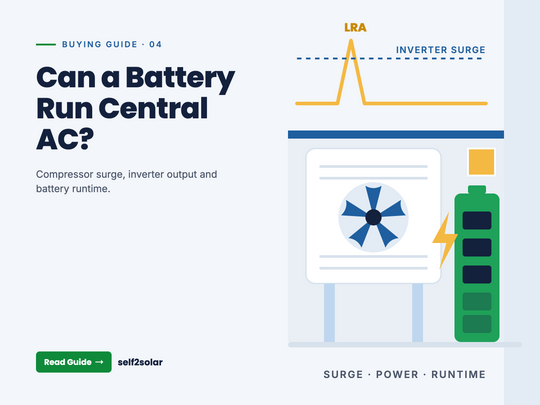
Can a Battery Run Central Air Conditioning?
Check compressor surge, inverter output and battery runtime before sizing.
Read Guide →
UL 9540 vs UL 9540A vs UL 1973
Understand battery, fire-test, system and inverter certification requirements.
Read Guide →Frequently Asked Questions
Is residential solar still worth it with recent utility policy changes?
It depends on your monthly electricity bill. Normally, if your monthly electricity bill over $300/month, the solar system is absolutely worth. Also, you have EV or have a plan to have a EV, the gasoline expense will shift to electricity bill, which can drive your electricity bill obviously surge. Solar system is the best solutions for it. With many states transitioning to policies like NEM 3.0 in California, traditional net metering (selling power back to the grid for full credit) is no longer profitable. Today, solar is absolutely worth it if paired with a battery storage system. By storing your excess daytime generation and using it during expensive peak hours (Time-of-Use rates), you can maximize your ROI and gain energy independence.
Can I add a battery to my existing solar system?
Yes. Adding Battery Storage to Your Existing Solar System
If you already have a grid-tie solar system without battery storage, we can upgrade it using one of two methods based on your current inverter's model and specifications:
1. DC-Coupled Battery Upgrade
This applies to systems already using a hybrid inverter. Our goal is to find a battery system that is fully compatible with your current setup:
- High-Voltage Hybrid Inverters: (e.g., Growatt MIN series, Solis S6 series). These require a high-voltage battery system that carries a certified UL 9540 system listing and has been officially tested for compatibility.
- 48V Low-Voltage Hybrid Inverters: These can typically be paired with standard 48V low-voltage batteries, utilizing universal RS485 communication between the battery and the inverter.
2. AC-Coupled Battery Upgrade
This applies if your existing system uses a standard grid-tie inverter with no backup capabilities. To enable backup power, we install a complete storage suite consisting of a Hybrid Inverter, Storage Battery, and Smart Gateway/Controller. Your existing grid-tie inverter will then be integrated via AC-coupling through the smart gateway.
Common grid-tie inverters that use this AC-coupled upgrade path include:
- SolarEdge SE Series Grid-Tie Inverters
- Solis S5 Series
- Enphase IQ7 / IQ8 Microinverters
- Hoymiles HM / HMS Series Microinverters
Not sure about your inverter's model or specifications? The Self2solar Team is here to help! Feel free to reach out anytime at: PrimeService@Self2solar.com
How many kWh battery storage system do I need?
The required capacity of a standard residential battery storage system typically depends on your daily power consumption and the size of your rooftop solar array. For instance, if you have a 10 kW PV system, assuming an industry-average of 6.5 peak sun hours per day, the system can generate approximately 65 kWh of electricity daily.
During the day, high-power household loads—such as pool pumps, refrigerators, air conditioning or heat pumps, and EV chargers—will consume at least 50% of this solar generation. The remaining 50% is stored in the battery system. Therefore, a 10 kW PV system is typically paired with a 20 to 30 kWh energy storage system.
Modern energy storage systems feature a modular, stacked design that offers plug-and-play installation and flexible scalability. Industry-leading options like the Sigenergy SigenStor All-in-One system, Growatt APX battery system, and FOX ESS PowerQ All-in-One system allow you to configure capacities anywhere from 10 kWh to 120 kWh. This means you can comfortably start with a 10 to 20 kWh setup, monitor its performance over time, and easily expand your battery capacity later based on your actual energy usage.
Can an 11.4kW inverter run my AC?
It depends on the AC starting surge, running watts, battery output, and load panel design. A soft starter or load management may be required.
A typical large 4-ton or 5-ton central AC unit uses about 4,000-5,500 watts (4-5.5kW) while running. The 11.4kW inverter can handle this easily, with plenty of room left over for your refrigerator, lights, and TV. For example, the Sigenergy Sigen 11.4kW controller has a 17.1kW surge peak for 10 seconds, which can help support two 5-ton central air conditioners when the full system is sized correctly.
If your system is off-grid or needs to power a whole home during an outage, the inverter is only the engine; the battery is the fuel tank. An AC drawing 5kW continuously will use about 5kWh of energy in one hour and can drain a standard 10kWh battery in about 2 hours of continuous running. To run an AC comfortably through a hot afternoon or overnight, you will usually want a battery bank of at least 20kWh-30kWh paired with that 11.4kW inverter. Many modern battery storage systems also include a smart load hub, allowing selected circuits to be connected to controllable breakers and managed through an app or software.
What is the difference between whole-home and partial backup?
Whole-home backup is designed to support most home circuits, while partial backup focuses on selected critical loads such as refrigeration, lighting, internet and key outlets.
Does UL9540 apply to the battery or the whole system?
UL9540 generally applies to the energy storage system configuration ( inverter and battery system). Individual batteries may also carry standards such as UL1973 or UL9540A test data, the inverter carries UL1741.
Subscribe to Win
Be the first to receive our latest news and exclusive 5% OFF!
